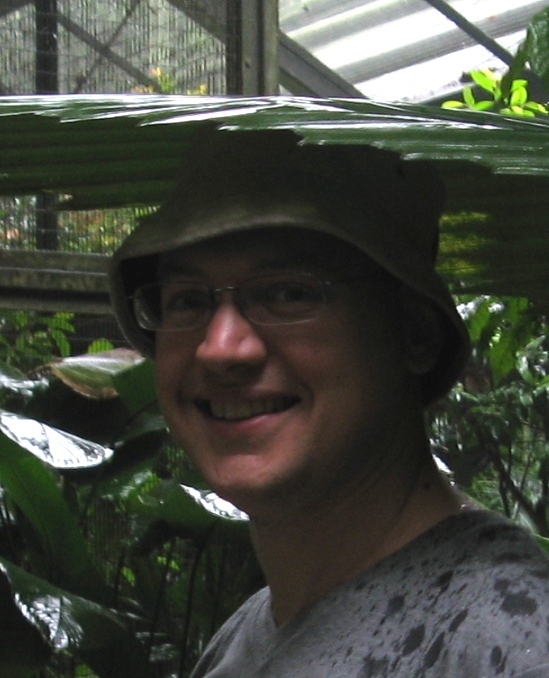
Gwenn Englebienne


Contact Information

Dr Gwenn Englebienne
University of Amsterdam FNWI
Science Park 904
1098XH Amsterdam

Tel: +31 20 525 8605
email: G.Englebienne(at)uva.nl


Research Interests

I am interested in Machine Learning in general and Bayesian probabilistic modelling in particular. I am fascinated by how we can create machines that can perform better than we do at tasks we don't even know how to do. My interests are in how to represent knowledge, manipulate it, and act on it — and how our endeavour to let machines do this tells us something about ourselves. The main focus of my work is on approximative inference in the case of complex models, large datasets, deep architectures, computer vision, etc.

Projects

I am currently working on the following project:
Healthlab
In this project, we use simple binary sensors to measure how the state of health of elderly people evolves over time. In combination with the Vrije Universiteit, we investigate how we can intervene in the process by coaching people automatically to exercise more or have more social contact.
In the past, I have been working on:
Zorgen voor Morgen
We are recording and analysing large, real-world datasets of elderly people living alone. The recordings consist of simple binary sensors as used in the Cogniron project (below), but are more numerous, installed in many more houses, and record for months at a time.
NICCAS
This project focusses on tracking people with widely distributed camera's. It is a cooperation between the UvA and Eaglevision.
COGNIRON:
Within the context of the COGNIRON project we have aimed to achieve automatic, non intrusive monitoring of the health state of elderly people, by analysing patterns in simple binary sensor data (such as binary sensors on doors, electric appliances, etc.

Teaching

I teach the Machine Learning: Pattern Recognition master's course at the UvA. This is a challenging course for master's students, which provides a solid introduction to Machine Learning and Pattern Recognition, with a focus on probabilistic modelling. The book of the course is Chris Bishop's Pattern Recognition and Machine Learning, and we cover pretty much all of the topics in the book with this course, with occasional side-excursions to cover additional material.

The course consists of a weekly two-hour lecture, a two-hour exercise session and a two-hour lab. The exercise sessions follow the lectures and reinforce the material by providing exercises that prove or illustrate items seen in the preceding lecture. The computer labs provide more hands-on interaction with the material. Examples of labs include: implementing logistic regression, the E.M. algorithm for mixtures of Gaussians, an email spam filter, face recognition using principal component analysis, etc.

Prof. Dariu Gavrila provides two guest lectures where the application of pedestrian detection from a moving vehicle is used to highlight such issues as feature selection, very high accuracy recognition, dealing with very large datasets, real-time constraints, etc.

Cover illustration

Supervision

Ph.D. Students

Current students

I am supervising the following PhD students at the moment:

Ex's

The Ph.D. students who are students no more

M.Sc. Students

MSc students that I am currently supervising Students that whose projects I supervised in the past

Academic Efforts

Selected publications

2012 2011 2010 2009 2008 2007

Other things

A short CV can be found here. In brief, I started off as an Engineer in Electronics, worked for a few year as an embedded software developer, did another masters in computer science at the University of Manchester where I stayed on for a Ph.D. under the supervision of Magnus Rattray and Tim Cootes. I am now a postdoc researcher in the Intelligent Autonomous Systems (IAS) group at the University of Amsterdam.

GPLed code

RPC, the reverse polish notation calculator

This program was written to scratch a long-standing itch of mine, namely that I couldn't find a decent simple calculator for Linux. I've tried a few, and all had aspects I didn't want to live with. (Some require the use of a mouse to access certain functions, some don't allow the easy re-use of the result of the last calculation you did, some don't have undo/redo functionality, etc.) So in the end I wrote this.

It's a console-based, very light-weight calculator using the reverse polish notation for its input, providing a history of the calculations leading up to the latest result, with infinite undo/redo stack, and with edit history.

It's far from perfect and in fact I don't think it's very likely to be liked... But it sucks less than any other simple calculator program out there, including even 'bc -l'. ;-)

The source code of the latest version (0.5.3) is available here [tar.gz][tar.bz2]